
What the Ontario Warehouse Fire Reveals About Industrial Fire Protection
On April 7, 2026, a six-alarm fire tore through a 1.2 million-square-foot distribution center in Ontario, California. It took 175 firefighters and nearly 12 hours to extinguish. The facility, and everything inside it, was declared a total loss with damages estimated at $600 million.
The sprinkler system was active the entire time.
That detail deserves to sit for a moment. The internal fire suppression system was on. Firefighters responded quickly. And the building still burned for half a day before it was contained.
This is not a story about a system that failed because it was poorly maintained or improperly installed. It is a story about the limits of what conventional suppression systems were designed to handle, and what happens when fire conditions push past those limits.
Industrial operators across the U.S. need to understand those limits. Because they are far closer than most facility managers realize.
Why This Fire Matters to Industrial Operators
Distribution centers, food processing plants, paper and packaging facilities, and cold storage warehouses share a common risk profile: high fuel loads, large open floor plans, and suppression systems designed around statistical assumptions about how fires start.
The Ontario facility was storing household paper products, one of the most combustible commodity categories in distribution. But the structural dynamics that caused this fire to outrun its suppression system are not unique to paper. They apply anywhere you have:
- Large volumes of combustible material stored in close proximity
- High ceilings and open racking that allow fire to climb and spread laterally
- Suppression systems that respond to established fire rather than detecting it at origin
Food processing facilities deal with oils, fats, dusts, and biomass. Packaging operations house corrugated, foam, and film. Logistics centers store everything from textiles to chemicals. The fuel profile differs. The fire behavior dynamics do not.
What burned in Ontario could inform what burns next, if operators do not ask the right questions about their own systems.
What Happened Inside the Building
To understand why the sprinklers could not stop this fire, it helps to understand how conventional sprinkler systems are engineered.
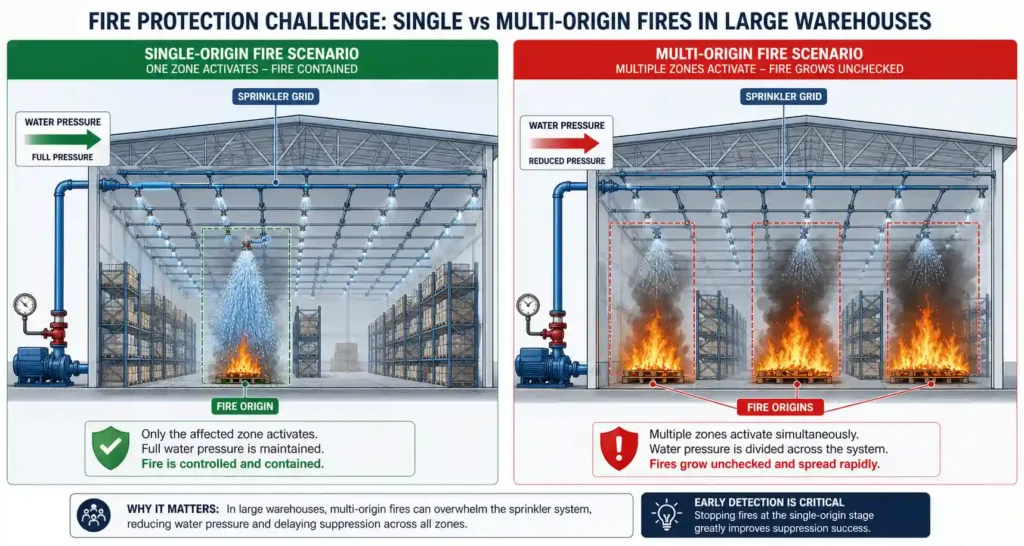
Standard wet-pipe and dry-pipe systems are designed around a single-origin fire model. A fire starts at one location, heat rises, and the nearest sprinkler head activates when it reaches a thermal threshold, typically between 155°F and 200°F. Water flows to that zone. The fire is suppressed.
That model works well for the fire scenarios it was designed to handle.
The Ontario fire presented a different scenario. The fire originated across multiple locations within the facility in a compressed time frame. When that happens, the suppression system faces a hydraulic challenge it was not sized to solve.
Hydraulic overwhelm: When multiple sprinkler zones activate simultaneously, the system must distribute water pressure across all of them at once. The result is a significant and rapid drop in pressure at each individual sprinkler head. Instead of delivering a concentrated flow to suppress fire at a single origin, the system disperses water at reduced pressure across multiple zones. No zone receives adequate suppression. The fire grows in each location.
Structural failure cascades: As fire intensity increased, the roof structure was compromised. When sections of the roof collapsed, they severed the main sprinkler supply lines. At that point, the facility’s internal defenses went offline entirely. Firefighters transitioned to a defensive exterior strategy, protecting the surrounding area rather than attempting to save the structure. The building was already lost.
The sequence took hours to fully play out. But the outcome was determined far earlier, at the moment the fire exceeded the design parameters of the suppression system.
The Detection Gap Is Where Fires Are Won or Lost
Here is the core problem with a suppression-only fire protection strategy: by the time suppression activates, fire is already established.
A standard sprinkler head requires heat to build to its activation threshold. In a high-fuel-load environment, fire can double in size every 30 to 60 seconds. That means from the moment of ignition to the moment a sprinkler head triggers, a fire has already consumed significant material and generated enough heat to begin affecting adjacent zones.
In a standard office or retail environment, that lag is manageable. In a 1.2 million-square-foot warehouse filled with combustible product, it is not.
True infrared (IR) detection changes this equation at the fundamental level.
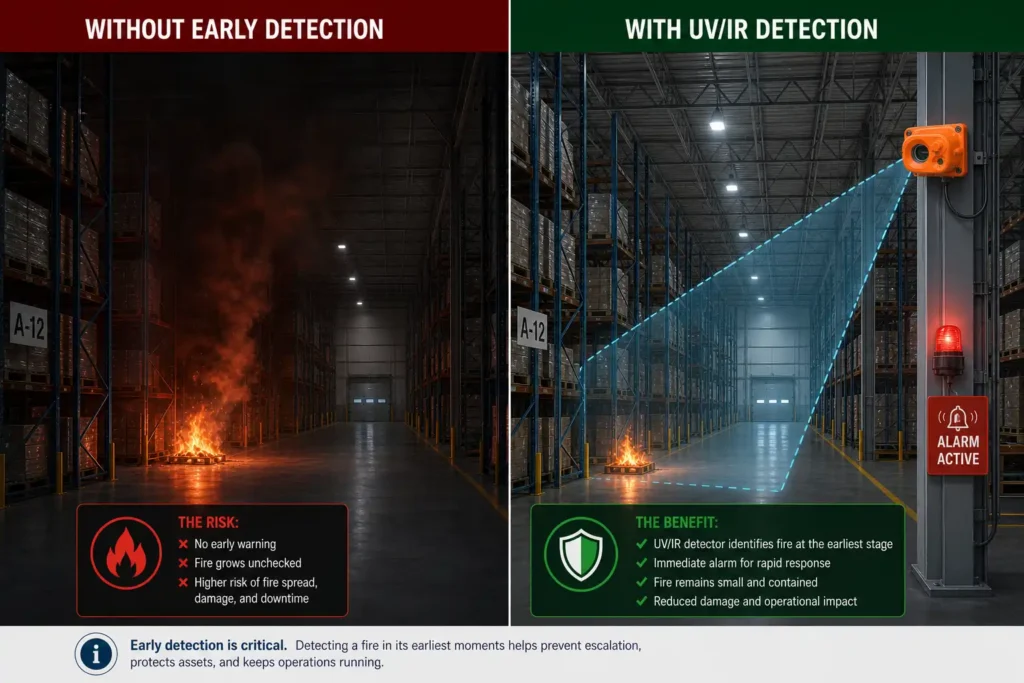
IR detection does not wait for heat to accumulate at a fixed point above a fire. It identifies the unique electromagnetic signature of a fire event, the specific infrared radiation that combustion produces, at the moment of ignition. Not when smoke reaches a ceiling detector. Not when heat trips a thermal threshold. At ignition.
That distinction is the difference between catching a fire when it is one pallet burning and responding to it when it is twenty.
Early detection does not replace suppression. It completes it. When a fire is identified at origin, the window for effective suppression response is open. The system can deliver targeted intervention before hydraulic overwhelm is possible, before structural integrity is threatened, and before firefighters are forced to abandon interior operations.
The sprinklers in Ontario were not the problem. The problem was that by the time suppression activated, the fire had already exceeded what any suppression system could contain.
The Unknown Threat: Planning for What You Cannot Predict
Every industrial fire risk assessment accounts for known ignition sources: electrical faults, equipment failures, friction heat, hot work operations. Those are the scenarios fire protection engineers design around. They are statistically the most common origins. They should be accounted for.
But facilities that only plan for known, predictable fire scenarios are building their protection strategy around incomplete assumptions.
Fire does not always start where you expect it to, in the way you expect it to, or at the time you expect it. Equipment behaves unexpectedly. Processes go wrong in novel ways. Fire events that fall outside statistical norms still happen.
The question for every industrial operator is not only: “Are we protected against the fires we expect?” The question is: “What happens when fire starts in a way our system was not designed to handle?”
A multi-layer fire protection approach, one built on early detection as the foundation with suppression as the response mechanism, is the only framework that performs across both expected and unexpected scenarios.
True IR detection does not care how a fire started. It does not require prior knowledge of an ignition source. It detects the fire event itself, regardless of origin, regardless of location within the facility, and regardless of whether that origin was anticipated in the original risk assessment.
That is not a feature. It is an architectural difference in how fire protection is designed.
What Advanced Detection Looks Like in Practice
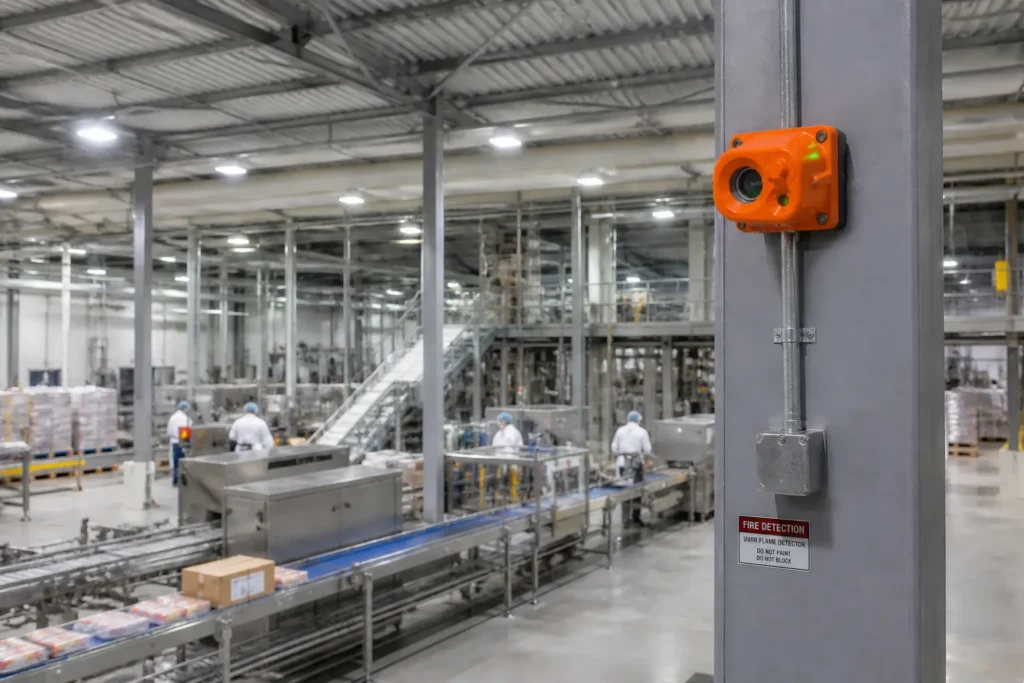
RDi deploys Firefly True IR detection systems engineered specifically for the demands of industrial environments. These are not commercial smoke detectors scaled up. They are fire detection systems built for large open spaces, high ceilings, heavy equipment environments, and the thermal complexity of active industrial operations.
Key capabilities relevant to the risk profile discussed here:
True IR detection at ignition: Firefly systems identify fire events using infrared imaging tuned to the specific spectral signature of combustion. The system detects actual fire, not heat accumulation, not smoke density, not rate of temperature rise, which means detection occurs at origin, not after propagation.
Wide-area coverage in open facilities: A single Firefly sensor can monitor large areas of open floor space and high racking that traditional detector arrays cover poorly. In large-format facilities like distribution centers or food processing plants, this changes the coverage equation significantly.
EXIMIO control integration: Detection data feeds into the EXIMIO control platform, which enables zoned suppression response, alarm sequencing, and integration with existing facility systems. When detection triggers, response is targeted and coordinated, not a facility-wide loss of water pressure.
IntuVision operator interface: Facility and safety teams receive clear, real-time visibility into detection events. This supports faster human decision-making and better coordination with responding fire services, both of which matter when seconds determine whether a fire is contained or catastrophic.
RDi’s approach is solutions-first. Every engagement starts with understanding the specific fuel load, facility geometry, occupancy patterns, and risk profile of the operation. The system design follows from that analysis, not the other way around.
Questions Every Industrial Operator Should Be Asking
The Ontario fire offers a clear lens for evaluating your own facility’s fire protection posture. Consider these four questions:
- What are the design assumptions in our suppression system?
- How many simultaneous ignition zones can your sprinkler system handle at rated pressure? When was the hydraulic design last reviewed against current fuel loads and racking configurations?
- What is our detection lag?
- From the moment a fire starts in your facility, how long before your detection system triggers? What does the fire look like at that moment? Is suppression still a viable response?
- What scenarios fall outside our protection design?
- What fire events could your current system not handle, not because of equipment failure, but because of the system’s design limitations? Have those scenarios been documented and addressed?
- What happens if suppression fails mid-event?
- If primary suppression is compromised by pressure loss, structural failure, or supply interruption, what is the fallback? Does the detection layer remain operational independently?
These are not hypothetical questions. They are the questions that the Ontario fire answers, at a cost of $600 million.
The Cost of the Gap
The Ontario fire did not fail because the wrong equipment was installed. It failed because the protection strategy had a gap, and the fire found it.
That gap exists in more industrial facilities than most operators recognize. Not because of negligence. Because suppression-first thinking has been the industry standard for decades, and most facilities have never had a reason to question it.Until they do.
A sprinkler system tells you a fire has grown large enough to trip a thermal threshold. IR detection tells you a fire has started. That difference, measured in seconds at ignition, is the difference between a contained event and a total loss.
The Ontario facility is gone. The question every industrial operator should be sitting with right now is a simple one: if fire started in my facility today, in a way I did not expect, would my system catch it in time?
If you are not certain of the answer, RDi can help you find it.
Talk to RDi About Your Facility’s Fire Protection Gaps
RDi has spent 30 years solving complex fire problems in industrial operations. If the questions raised in this article apply to your facility, we would welcome the conversation.
Schedule a consultation with an RDi engineer to review your current detection and suppression infrastructure and identify whether your system is designed to handle the full range of fire scenarios your facility may face.